 English
 Spanish
 Germany






Online examinations: Everything you need to know about going digital
What is an online examination?
Online examination is a process of conducting examinations with the help of an internet connection. It requires candidates to answer questions within a pre-decided timeframe. The test window collapses once the exam is over, and institutes get real-time reports. Evaluators then assess the answers and grade accordingly. A fully automated system supports objective evaluation and helps generate results faster than in a traditional exam format.
Most online exams include answer processing modules, allowing evaluators to issue results moments after the candidates complete the test. However, evaluators may assess answers in person for long-answer-type questions where results are not automated. The results of the online exams are then conveyed to the candidates via email or published on the institute’s website.

Types of online examinations
With advanced proctoring and custom exam solutions, it is now possible to host a variety of exams using the online mode. A few of the prominent online exam types include:
- Semester exams and entrance exams
- Coding and programming assessments
- Aptitude tests and personality profiling
- Video interviews and viva
- Mock practice tests
- Image-based or media-based online exams
- Open-book tests
- Competitive exams and contests
How to design effective online exams?
Designing effective online examinations can be a daunting task, but it is essential for educators to gain valuable insights into student performance. Here are some tips to keep in mind for valuable outcomes:
1. Draw a connection between assessments and learning objectives:
It is necessary to ensure that each assessment is aligned with specific learning goals. This method helps offer clarity for students and maintain focus on key outcomes and optimum student performance.
2. Integrate online learning assessments at different touchpoints:
Implement a blend of formative and summative assessments at different touchpoints in the student journey. For example, a series of online assessments throughout a short-term course can be used to monitor the progress of students continuously and keep them engaged.
3. Offer clear instructions and constructive feedback:
Test evaluators should develop detailed guidelines for each assessment to ensure seamless execution of the examination process. It is also important to provide timely and specific feedback to promote a growth mindset and continuous improvement.
4. Align questions with the real world:
Design assessments that reflect real-world scenarios to make learning more relevant. These scenario-based questions are engaging for students, and they develop critical thinking abilities.
5. Create a high-quality question pool:
Create concise questions in simple language aligned with learning objectives. Revisit, review, and update these questions from time to time to maintain quality and relevance.

How do online exams work?
Process of an online test
The online test process usually includes five steps.
Step 1: System setup
Examiners or admins set up the testing environment and upload questions to the online exam platform. LMS integration and result configuration also happen at this stage.
Step 2: Test link sharing
Examiners upload bulk candidate data to the platform, select time slots, and share the test links with students via email. Here, examiners can also allow students to select a desired time slot.
Step 3: Candidate authentication
Test-takers use the link to log in and attempt the test via three-step authentication. The tests are usually recorded and can be proctored for important examinations via AI-based or human proctors.
Step 4: Student performance evaluations
Once students submit the test, it can be auto-evaluated for real-time report generation or sent to evaluators for review. The results can be customized and shared in PDF or HTML formats.
These reports share valuable insights into students’ performance in different areas, which can serve as a benchmark for further evaluation, training, or development.
Step 5: Analytics
An in-depth analysis of the online examination can be done in the form of group-level analysis, and the reports can be customized as needed.

Monitoring online exams
Online exams are monitored via proctoring technology, which can be classified into three categories:


Implementing online examinations with the right software
The first step to choosing the right online examination software involves outlining specific business requirements. That makes it easier to select the software that best suits the organization. There are several options to explore, but before choosing a vendor, consider the following aspects:
- The vendors’ market experience
- Their service fee for online exam services
- The features offered by their online test platform
- User-friendliness and the contours of the software’s user interface
- The vendor’s clientele and standing in the market
The most valuable features of an online exam platform
It is ideal to choose an online exam platform that promises the following:
- Ability to create engaging online exams by adding images, text, video, complex equations, etc., to the questionnaire
- Ease of use and high-test credibility
- Support for multiple question types, such as multiple-choice image questions, multiple-choice questions, audio-video questions, fill-in-the-blanks, etc.
- Flexibility to create a comprehensive question bank with a variety of questions as part of online exams. Moreover, it should allow examiners to randomize problems to maintain the uniqueness and relevance of the test’s content.
- Room for end-users to use tags for their question banks, create new tags and assign the proper tags to each question for analysis.
- Ability to set pass and fail rules for exams. For instance, the software should enable the administration to set the time limit and the number of attempts for each question. Also, candidates should be allowed to review their answers before submitting them.
- Custom styling and personal branding options (white label solutions) to create a lasting impression on test-takers.
Advantages and disadvantages of conducting online tests
Advantages of online tests
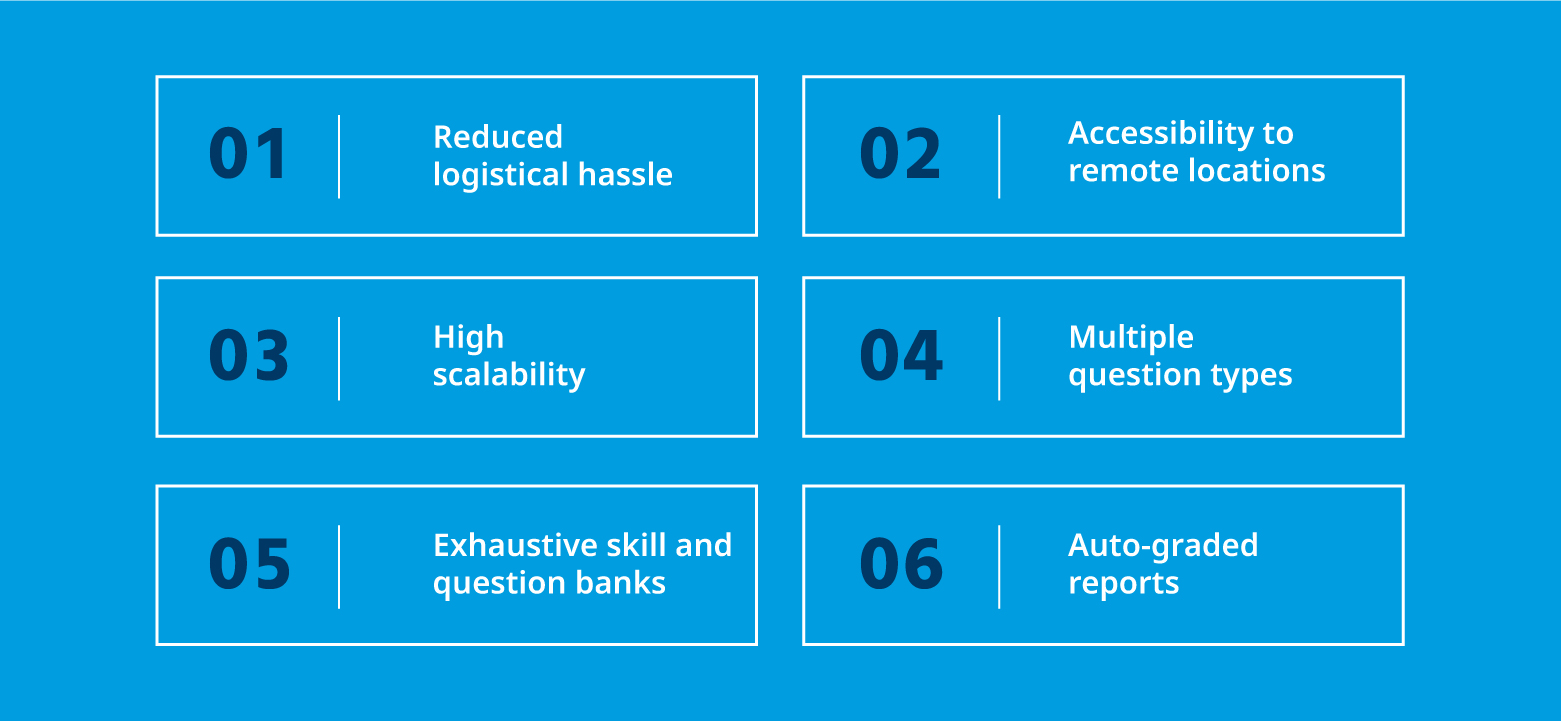
Reduced logistical hassle
Online exams overcome the challenge of setting up physical test centers, minimizing resource requirements, such as time, cost of setting up, and the need for human proctors.
Online exams accelerate the admission process in universities, where applications can be screened with minimal resources.
The idea of conducting semester exams and various assessments online lends ease and seamlessness to the entire process.
Improved accessibility
Online exams have broken geographical barriers and enabled wider reach and participation. Global assessment solutions train universities and education sectors, allowing them to conduct assessments efficiently.
Enhanced scalability
Online exams can cater to a broad audience and easily manage vast content. Considering this feature, educational institutions facing a scarcity of time would find it highly convenient to conduct examinations with the least bandwidth wastage. Merely a computer with an active connection and a webcam to take tests makes this possible.
Increased options for question types
Online exams range from MCQs, fill-in-the-blanks, and checkboxes to short answers, long answers, coding simulators, case studies, etc. In addition, online examination platforms support a host of knowledge and application-based questions, enabling examiners to prepare a questionnaire with multiple question types.
Better question banks
Advanced online examination test platforms have an exhaustive library of competencies and sub-competencies, carefully mapped to relevant questions. For ease of use, examiners can choose the relevant skills they wish to test via the exam to frame the questionnaire. This saves examiners’ time and effort.
Auto-graded reports
Automated reports do away with human intervention and save notable working hours. A report is a comprehensive approach to a candidate’s performance, with a question-wise and section-wise summary of the attempt, time taken, and difficulty level. Detailed reports are also helpful for students seeking career guidance.
Disadvantages of online tests
While the advantages of online examinations are undeniable, it's essential to recognize the drawbacks before implementing an online examination system to ensure improved efficiency.
Internet dependency
Online examinations are reliant on internet access. A stable internet connection is necessary for seamless examinations, and poor network connectivity can disrupt the process.
Technical challenges
Despite the pervasive role of technology, technical issues can still arise during online exams, such as portal navigation problems and system crashes.
Lack of technical proficiency
Students need to possess adequate technical knowledge to effectively participate in online exams. A lack of technical knowledge can hinder the successful execution of online assessments.

How Mercer | Mettl can help
Mercer | Mettl’s online examination platform helps securely conduct crucial assessments using advanced online proctoring features. In addition, the tool enables end-users to manage the end-to-end online assessment process. From online registration and test creation to center management and real-time reporting, the entire process is centered on assisting clients in conducting assessments with the utmost ease.

Candidate authentication
The platform eliminates any impersonation risk by ensuring multi-factor authentication using OTP, Aadhar, biometrics or IP, followed by ID authentication. It also involves facial recognition, which takes the candidates’ pictures and ID proof to avoid impersonation.

Safe Exam Browser
Mercer | Mettl's exam browser prevents candidates from accessing other tabs. Once enabled, this feature detects and ends the test for the examinees who browse away from the test window and open multiple tabs on the browser.

AI and human proctoring
It enables monitoring of candidates’ behavior and actions for suspicious activities. With enhanced cheating prediction abilities, Mercer | Mettl’s proctoring technologies combine the latest advances in AI-based and live remote proctoring to eliminate the risk of cheating.
Conclusion
Online tests have unquestionably become a more efficient medium of assessing candidates’ knowledge and aptitude. They allow flexibility for educational institutes to create, manage and evaluate examinees effortlessly. With quick assessment and real-time report generation, results can be declared immediately after the students have completed the test. Online examinations have revolutionized the education industry by automating in-person, tedious processes.
FAQs
How to prevent cheating in online exams?
How to take an online exam?
Can online examinations replace traditional interviews?
How can we ensure the integrity of online examinations?


Online examination, also known as virtual examination, is conducted remotely on a computer with high-speed internet. Like a classroom exam, it is time-bound and usually supervised through a webcam and proctor, making it cheating-free, secure and easily scalable.














Get awesome marketing content related to Hiring & L&D in your inbox each week
Stay up-to-date with the latest marketing, sales, and service tips and news
By using our offerings and services, you are agreeing to the Terms of Services and License Agreement and understand that your use and access will be subject to the terms and conditions and Privacy Notice