 English







What is performance appraisal: Process, uses, benefits and more
Introduction
Performance appraisal, also known as performance review, is the process of assessing a professional’s progress, job-relevant skills and areas of development, over a set period. The goal of performance appraisal is to facilitate unbiased and informed talent decisions like promotions, pay raises, training interventions and career development.
This blog delves into the key elements, processes, advantages and other essentials of efficient employee performance reviews. You will also learn about choosing the right software and tools to upgrade performance management initiatives in your organization.
Chapter 1: What is performance appraisal
Performance appraisal or review is part of the larger employee performance management system. It is a formal and regulated mechanism to enable decision-makers offer constructive feedback, initiate skill development, support growth paths and assist with realistic goal setting. Moreover, a regular work performance review is crucial for organizations to assess their talent strategies, employee compensation and L&D investments.
Key objectives of performance appraisal in HRM
The core purpose of staff performance appraisal is often termed as comparison of the standard performance set by the organization with the actual performance by the employee.
For most organizations in the United States, performance reviews are used to support decisions related to training and career development, compensation, transfers, promotions, and reductions-in-force or employment termination. Generally, the performance review process includes setting clear and specific performance expectations for each employee and providing periodic informal and/or formal feedback about employee performance relative to those stated goals.
Major performance appraisal objectives include:



Individual and team-development objectives encompass:

Importance of employee performance review in an organization
A well-planned and executed performance appraisal system boosts employee engagement. It further sets the tone for nurturing a culture of feedback and ongoing development at the organization. It also helps prevent and solve performance problems in the workforce by identifying specific strengths and development needs.
You will learn more about the advantages of regular performance review in the fourth chapter of this blog.
Chapter 2: Decoding the process: Vital elements, methods and types of performance appraisal
An effective performance appraisal comprises six essential elements:
To ensure the success and validity of a performance review, it is vital that each of the above elements corresponds to the key steps that make up a performance appraisal process. To streamline the review, one can also use performance management solutions.
What are the six steps in a performance appraisal?
To ensure systematic and holistic evaluation of employees, it is crucial to include all essential components in your performance appraisal process, corresponding to the steps below.
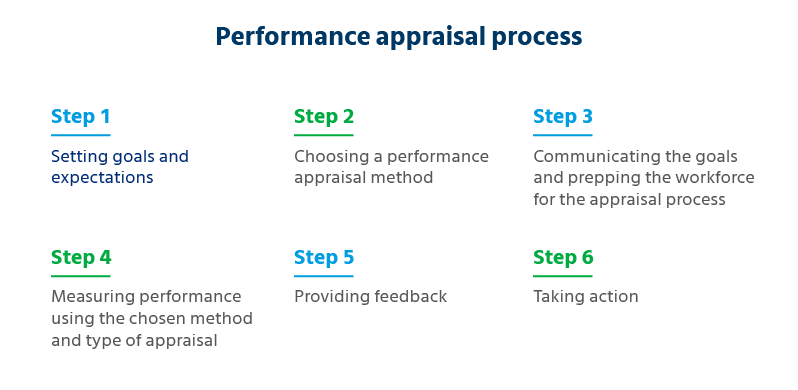
Step 1: Setting goals and expectations
Before initiating any kind of employee performance review, it is imperative to have complete clarity about the objectives and purpose of the review. Therefore, goal setting should happen at various levels.


Step 2: Choosing a performance appraisal method
The type and method of performance appraisal you choose depends largely on the organizational and individual goals set in the first step. The last section of this chapter introduces you to the most recommended methods and the most popular types of performance review systems. It also highlights the effectiveness and approach of each, giving you an idea of how they connect to your organizational objectives.
Step 3: Communicating the goals and prepping the workforce for the appraisal process
Communication and training are the most crucial next steps in the performance appraisal process. Organizations should discuss performance standards with every member of the workforce to establish a complete understanding of goals and expectations. Whenever required, there should be a training period before any employee is ready for performance monitoring or review. Furthermore, employees should receive complete information about how and when their performance would be evaluated.
Step 4: Measuring performance using the chosen method and type of appraisal
A combination of tools like a virtual assessment center, multi-rater feedback, skill assessments, etc. often ensures the most reliable analytics. Therefore, organizations should adopt a multi-pronged approach to ensure holistic performance measurement.
Step 5: Providing feedback
Feedback and discussion about the appraisal analytics is crucial for motivating, supporting, directing, correcting and regulating work efforts and outcomes. It ensures that managers and employees are working together toward meeting work standards and expectations.
Regular feedback sessions help:
Step 6: Taking action
The final step in the appraisal process is the discussion and/or implementation of any next steps such as:
- Rewards: a raise, promotion or coveted development opportunity
- Corrective measures: a Performance Improvement Plan (PIP) or termination
- Development strategies: executive coaching, succession planning discussions, mandatory training, role-change briefing, etc.
Most recommended performance appraisal methods
There has been significant transformation in the way organizations approach employee performance reviews. As traditional annual appraisals tend to grow ineffective, there is an array of modern alternatives to choose from, including:
- 360-degree feedback
- 720-degree feedback
- Assessment center method
- Psychometric assessments
- Competency assessments
- Behaviorally Anchored Rating Scale (BARS)
- Performance check-ins
The blog “Seven modern performance appraisal methods to boost workforce development” offers detailed insights into the right approach and potential of the most recommended performance appraisal methods listed above.
Types of performance management system
Three types of performance appraisals are most popular among organizations globally- periodic performance reviews, potential appraisals and MBO. The employee appraisal methods listed earlier can help amplify the efficacy of any type of performance management system that a company chooses.
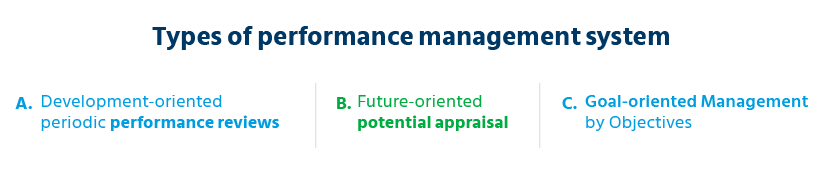
Development-oriented periodic performance reviews
Periodic employee performance reviews measure individuals’ growth, achievements and professional competency displayed during a specific duration. An annual performance appraisal or an equivalent monthly/quarterly review are examples of periodic work appraisal systems.
Most effective for: Initiating targeted development plans and nurturing a high-performing workforce.
Future-oriented potential appraisal
Potential appraisal refers to the identification and evaluation of hidden talents and underlying skills of a person. This type of appraisal system attempts to predict how well employees are likely to perform instead of obsessing over how well they have been performing.
Most effective for: Succession planning and building a leadership pipeline.
Goal-oriented Management by Objectives
Management by Objectives or MBO refers to a performance management system where every employee receives a definite set of goals, aligned with the organizational mission. Mangers then consistently monitor performance toward achieving each goal.
Most effective for: Meeting business targets, encouraging healthy competition and keeping the teams motivated.
Chapter 3: Performance review do’s and don’ts: Best practices to ensure efficiency
There are several considerations that you should not overlook when implementing a performance appraisal system in your organization. This chapter deep dives into the dos and don'ts that are vital to the success of any type of employee appraisal or review.
The do’s: Things to remember when implementing a performance appraisal system
It is essential to engage all relevant stakeholders when upgrading the annual performance review in your company. It ensures ongoing support and active participation throughout the process. Additionally, there are the following important parameters to consider as part of your performance appraisal best practices.

Choose a relevant competency framework
A successful employee performance review is always based on industry-specific and position-specific competencies. You should be vigilant when choosing an employee performance review format so that the assessment can cover all necessary and desired competencies for each role.

Set realistic goals and expectations
Striking the right balance is imperative for effective goal setting. Goals should not be too easy to achieve nor unrealistically difficult. There has to be a sweet spot where every employee enjoys a challenge while feeling content about working toward it. Goals should allow room for expanding skills and knowledge and be tracked regularly.
Similarly, expectations placed on employees need to be credible. Every individual should feel confident and capable about fulfilling the said expectations. The latter should be:
- Clear, specific and understandable
- Based on job function
- Geared toward fostering constant improvement in productivity and skill development
- Verifiable, results-oriented and communicated on time

Document performance throughout the year
Regular performance reviews are essential to maintain efficiency and reliability in the employee appraisal process. Regular reviews help prevent biases and judgement based on recent events. When you have documented evidence of consistent good or bad performance, the ultimate reviews tend to be data-backed and objective.

Provide feedback with a purpose
Employees want feedback delivered with clear improvement plans. Therefore, it is important to offer:
a. Sufficient information about improvement points
b. The right amount of support to make the suggested improvements.
Remember that improved performance can only occur through proper coaching, guidance, training and employee support. Open and honest performance conversations are crucial for the same.

Maintain honesty, transparency and positivity
A key element of work appraisal is mindful selection of evaluation phrases. Meaningful and action-oriented words have a far greater impact than more standard phrases such as "good" or "satisfactory". The last section of this chapter enlists a few example phrases you can use to maximize the review’s impact. The key is to encouraging, appreciative and practical while using words like “demonstrates”, “exhibits”, “excels”, “monitors”, “achieves”, etc.
After the performance appraisal conversation, managers and employees should:
- Record notes from the meeting.
- Reflect on how the meeting went and what can improve future meetings.
- Plan for follow-up discussions on any open issues and check in on goals.
The goal of performance appraisal should not be limited to performance review alone but more focused toward employee development.
Tips for employees: How to prepare for a performance review
For employees, performance review is a valuable opportunity to talk about their achievements and future plans. However, the more growth-oriented your approach, the more successful your review is likely to be.


A work journal helps:


The don’ts: Mistakes to avoid for a successful employee appraisal
As you’re planning or reviewing your performance review process, you can save time and expense by being aware of these potential failure points.
Mistake 1: Lack of communication
Communication is the most critical component of implementing a new or improved performance management system. Authentic and transparent information sharing is part of the training process that enables managers to take control and lead by example. The goal is to have everyone invested in the performance evaluation process.
Mistake 2: Not following up
When performance is rated below expectations, managers need to take and follow through with corrective actions such as designing performance improvement plans. Otherwise, the appraisal system fails as a development tool, negatively affecting morale.
Mistake 3: Making criticisms without any context or offering false praise
While you should look for something positive to say in every performance review, giving false praise will only mislead an employee into thinking they are doing better than they are and rob them of the opportunity for improvement. Conversely, criticizing employees without giving appropriate examples or providing ideas for improvement can leave them feeling defensive and wrongly judged.
Mistake 4: Lack of planning
It is never acceptable to conduct a performance review meeting with your employees without sending them a prior notification about it. Performance reviews require both the managers and employees to be prepared. The agenda of the entire process is not just for you to assess their performance but also to analyze how to improve it.
Mistake 5: Turning it into a monologue
Performance reviews need to be elaborate discussions where employees and employers get equal opportunity to present their thoughts and ideas. Irrespective of the review format, the goal should be to make room for brainstorming, questions, planning and more.
Employee performance review phrases to include in the appraisal process
Performance review phrases provide a structure and direction to measuring critical competencies. These phrases may also invite ratings to highlight employees’ strengths and weaknesses. Alternatively, they can be very useful when writing review summaries.
Example phrases to measure creativity and innovation
- Initiates and executes new ideas such as…
- Is clever and imaginative when confronted with obstacles.
- Shows initiative with developing new ways of thinking to improve projects or company performance.
Example phrases about interpersonal skills and teamwork
- Recognizes the needs of others and reaches out to lend a helping hand.
- Clearly communicates ideas and thoughts in team meetings.
- Promotes cooperation well to ensure colleagues work as a team to meet deadlines
Performance review phrases about management ability
- Provides team with resources needed to attain results.
- Demonstrates the ability to turn negative energy into positive work energy through motivation and rewarding good work.
- Envisions the action plans and brings all the staff on board.
Examples phrases about problem-solving skills
- Displays the capability to independently solve complex problems.
- Breaks a problem down before analyzing it in a more detailed manner.
- Knows how to collaborate with others effectively to find solutions to problems.
Example phrases to use when talking about employee achievement
- Spearheaded [project] which resulted in [result]
- Improved production by X% through…. [specific task]
- Provides strong evidence of…. [specific accomplishment]
- Initiates and effective work system to streamline X processes by doing…..[specific contributions]
Chapter 4: Advantages and disadvantages of performance appraisal
The many advantages of performance appraisal put it at the top of the management tools list for organizations. Organizational growth depends on a well-performing talent pool and performance appraisal is the key to keep track of the same.
Seven major benefits of efficient employee performance review
An effectively implemented system of employee performance review can benefit all stakeholders in numerous ways.
Performance appraisal benefits for employees:
- Clarity about job expectations and goals.
- Self-assessment opportunities to track progress, boost motivation, define career paths and experience better job satisfaction.
- Harnessing ample learning and development opportunities for individual growth.
Performance appraisal benefits for employers:
- Higher employee loyalty, engagement and productivity supported by constant appreciation and recognition of individual contributions.
- Creation of a people-friendly environment that supports open dialog and healthy conversations about work targets, efforts, potential and achievements.
- Efficient work systems facilitated by clear communication and clearly defined objectives and progress paths.
- Documentation and structure in feedback processes, leading to a highly efficient talent management method.
Concisely, performance appraisal serves as a powerful tool for realizing organizational goals by implementing competitive HRM strategies. It helps in aligning and integrating the objectives with the KPIs in an organization both vertically and horizontally across all job categories and levels. It leads to driving all the organizational activities right from the bottom level toward one single goal.
Drawbacks of a conventional work performance review
The benefits of performance appraisal in HRM far outweigh the limitations. It is vital to remember that a holistic and modern method of staff performance appraisal is key to overcoming any disadvantages that may be hindering reviews, feedback and growth.
Traditional appraisal methods can have limitations like:
- Biases: Excessive leniency/severity, opportunity bias, halo/horns effect, similar-to-me/contrast bias, recency error, job vs. individual bias, generalization tendency, sampling error, etc.
- Focus on short-term rewards and a lack of data-oriented insights.
- Tendency to create negative impact: If not done right, results of a performance review can hamper employee morale, engagement and overall productivity.
- Ambiguity in standards and insufficient evidence to take objective decisions for rewards and development.
Chapter 5: How to choose the right tool for performance management in HRM
Implementing an efficient performance appraisal system in your organization is a wise investment to ensure clarity toward expected work behaviors and goals. Therefore, the tool you choose for this purpose should:
a. Enable a continuous movement toward helping professionals get better at their jobs.
b. Boost overall performance across teams.
Features to look for in performance appraisal tools
- Clear metrics of performance/goal completion success
- An automated/intuitive process
- Goal-setting support and logs
- Feedback flexibility and customization options
- Ease of use and constant user support
The SHRM toolkit on Managing Employee Performance outlines the significance of auditing and evaluating your existing performance management and appraisal systems.
“HR must continuously evaluate the system to determine if it is effective and to identify opportunities for improving it. Perception is reality when it comes to employee and managerial acceptance of a performance management process.”
- A good way to determine whether the system is being used consistently and administered fairly is to conduct an independent audit of the way the appraisal system affects various groups of employees.
- Adverse impact on a protected class raises legal concerns. However, adverse impact on any group should raise equity concerns. HR must take the responsibility for monitoring the system outcomes to ascertain that all employees are being treated in a consistent and fair manner, and that the system is supporting organizational goals.
How Mercer | Mettl can help
Mercer | Mettl strongly advocates the growth and implementation of insightful technologies for employee performance review. It offers a complete suite of tools to customize your performance management and appraisal system. If you follow the best practices, there are several strategic ways to leverage the power of these tools.
- 360-feedback software for reviews, identification of training needs, leadership development and more.
- Customizable virtual L&D platforms to drive change across various professional levels.
- Virtual assessment battery for measuring behaviors, technical skills, aptitude, personality traits, etc.
- Dedicated software to measure employee learning agility when identifying high potentials, building the leadership pipeline, taking promotion decisions, initiating new L&D programs, etc.
- Highly scalable, customizable, certified digital solutions to enhance the efficacy of your existing performance management processes.
Conclusion
An efficient performance appraisal system helps improve business and strengthen an organization’s existing workforce through dedicated L&D. Moreover, performance appraisal can be the catalyst for aligning leaders and creating a sense of urgency for new upgrades. By integrating multi-rater performance feedback like 360-degree review into their talent management plan, organizations can identify what’s most important for their strategic goals. Furthermore, a combination of assessments, platforms like virtual assessment centers and other modern work appraisal methods can guarantee numerous advantages for the company.
FAQs
How to conduct a performance review?
What are the three basic functions of an effective performance appraisal?
What is the best performance appraisal method?

Performance appraisal, also known as performance review, is the process of assessing a professional’s progress, job-relevant skills and areas of development, over a set period.

Get awesome marketing content related to Hiring & L&D in your inbox each week
Stay up-to-date with the latest marketing, sales, and service tips and news
By using our offerings and services, you are agreeing to the Terms of Services and License Agreement and understand that your use and access will be subject to the terms and conditions and Privacy Notice