 English







The ultimate guide to successful succession planning in 2026
The future of business resilience hinges on one critical factor - How effectively organizations unlock and mobilize skills.
This sharp shift reflects a growing recognition that future-ready organizations cannot rely solely on roles or titles; they must build workforces where skills, capabilities, and leadership potential are continuously identified and developed.
Succession planning sits at the foundation of this transformation. It is no longer just a contingency exercise for leadership replacement; it has become a dynamic process that aligns skill development, career progression, and business continuity. Yet for many organizations, the challenge lies not in recognizing its importance, but in moving from intention to execution. Challenges such as leadership gaps, skills mismatches, and inadequate development pathways often hinder progress. A comprehensive approach to succession planning can address these challenges by integrating advanced analytics, talent assessments, and targeted development strategies.
This blog provides a practical roadmap for organizations seeking to build resilient leadership pipelines. It is a guide through the journey of succession planning, from strategic alignment to actionable execution, empowering organizations to anticipate, prepare for, and respond effectively to future leadership needs.

Understanding succession planning in a competitive talent landscape
Leadership transitions offer a valuable opportunity to strengthen an organization when carefully planned and executed. Without a clear succession strategy, gaps in critical roles can threaten business continuity, stall momentum, and impact long-term growth. By taking a proactive approach to succession planning, organizations reduce risk and build stronger, agile leadership pipelines ready to meet future challenges. Embedding succession planning into broader talent and business strategies ensures smooth leadership transitions, preserves institutional knowledge, and positions the organization to thrive through change, turning potential disruption into an opportunity for renewal and progress.

Foundational elements of succession planning:
Empowering talent management and succession planning with Mercer Assessments
As leadership demands intensify and skill gaps widen, succession planning must evolve into a dynamic, data-driven discipline that goes beyond traditional approaches. Mercer Assessments provides a comprehensive framework to help organizations build resilient leadership pipelines, anchored in advanced research-based assessments and actionable insights.
Key components of Mercer’s succession planning approach include:

Critical role identification
Mercer helps organizations systematically identify roles that are pivotal to business continuity, growth, and transformation, ensuring succession efforts are sharply focused on where leadership gaps would have the most significant impact.

Successor mapping assessments
Leveraging a suite of validated psychometric and behavioral assessments, Mercer evaluates potential successors on leadership potential, cognitive agility, learning orientation, and business reasoning, offering deep insight into both current capability and future leadership capacity.

Enterprise-wide talent reviews
Through structured, evidence-based talent reviews, organizations gain a panoramic view of leadership bench strength across functions, levels, and geographies. This enables leaders to make informed decisions on where to accelerate development, address gaps, and recalibrate succession pipelines.

Leadership development and coaching
Leadership development must be closely aligned with the insights gathered during assessment. Mercer Assessments leverages rich psychometric, behavioral, and cognitive data to design targeted, competency-based development plans. This ensures that emerging leaders are identified and developed systematically through focused learning journeys, real-world simulations, role-based assignments, and continuous feedback loops.
In an increasingly competitive talent landscape, this integrated approach allows organizations to manage leadership risk and actively shape their future leadership bench with confidence, objectivity, and precision.
Building your succession strategy
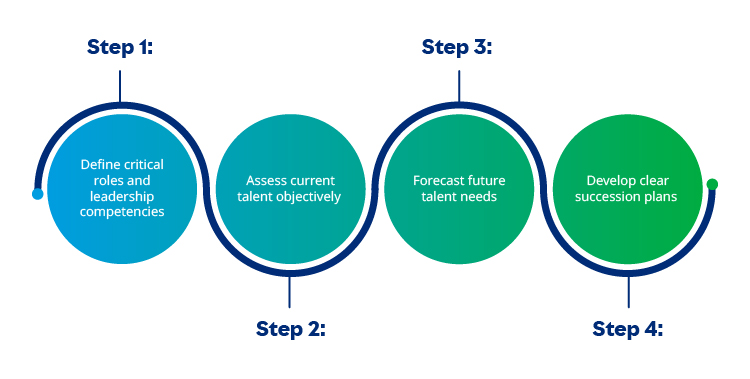
A strategic succession plan is rooted in alignment with business objectives and informed by rigorous data.
Step 1: Define critical roles and leadership competencies
Identifying roles important to organizational success is the first step in building a succession strategy. Define the leadership behaviors needed for current and future challenges, emphasizing adaptability, digital fluency, and strategic thinking.
Step 2: Assess current talent objectively
Using the standardized psychometric assessments and 360-degree feedback tools offered by Mercer Assessments minimizes subjective bias. The data from these assessments enable transparent evaluation and help reveal hidden potential.
Step 3: Forecast future talent needs
Using forecasting tools and insights from Mercer Assessments can help simulate talent demand under different market conditions and strategic initiatives, revealing potential gaps before they arise.
Step 4: Develop clear succession plans
Define successors for each critical role, specifying readiness timelines and development objectives. Moving forward, tracking progress and refining the plan helps continuously improve the succession plan for the future.
From planning to execution: Embedding succession in talent management
Effective succession planning starts with a deep understanding of your organization’s long-term business strategy. A successful plan doesn’t just focus on filling roles; it ensures that the leadership pipeline is aligned with the future talent management goals of the organization.
Integrate with performance management
Link successors’ development objectives directly to performance reviews to ensure accountability and momentum.
Invest in targeted development
Design learning journeys with a mix of formal training, on-the-job experiences, and mentoring.
Use technology to enable visibility
Mercer’s assessments provide real-time insights on talent pipeline health, enabling leaders to intervene proactively.
Communicate transparently
Build trust through clear communication with successors and stakeholders to encourage engagement and retention.
Measuring impact and driving continuous improvement
Continuous monitoring and refinement ensure succession plans stay relevant. Tracking these key metrics helps streamline leadership transitions:
- Time to fill key roles: A metric that reflects pipeline effectiveness.
- Internal promotion rate: A higher rate signals strong bench strength.
- Successor readiness: Percentage of successors ready now or within 1-2 years.
- Retention of high potentials: Tracks whether top talent remains engaged.
Feedback and adaptation
Establish regular review cycles and incorporate feedback from successors, managers, and executives to adjust development plans and respond to evolving business needs.
Overcoming common succession planning challenges
Leadership buy-in
Without senior executive commitment, succession plans lack traction. Starting with clear business impact data and engaging executives in defining critical roles improves leadership involvement in succession strategy.
Unconscious bias
Reliance on subjective judgment often limits diversity. Implementing standardized assessments and data analytics mitigates bias and fosters inclusive talent pipelines.
Agility in changing markets
Succession plans must be flexible. Organizations should be able to pivot plans based on market dynamics and talent availability.
Engagement of successors
High-potential leaders need clear development paths and consistent communication. Transparent dialogue and customized development can help retain successors.
Conclusion
Succession planning is imperative in today’s volatile business environment. Using an integrated approach, grounded in data analytics, rigorous talent assessment, and targeted development, empowers organizations to build resilient leadership pipelines aligned with their evolving strategies.
By moving beyond reactive planning to proactive talent ecosystem management, organizations can mitigate risk, drive growth, and sustain competitive advantage.
FAQs
1. Is succession planning only for executives?
2. What is the difference between succession planning and succession management?
3. How long does succession planning take?
4. Which model is most used in succession planning?
5. What is succession planning in human resource management?


Succession planning is a systematic process through which organizations build a leadership pipeline to preserve its future. The process involves identifying and developing potential successors for a seamless transition.




Get awesome marketing content related to Hiring & L&D in your inbox each week
Stay up-to-date with the latest marketing, sales, and service tips and news
By using our offerings and services, you are agreeing to the Terms of Services and License Agreement and understand that your use and access will be subject to the terms and conditions and Privacy Notice